Small-business plumbing repair is the diagnosis and correction of leaks, blockages and faulty fixtures to keep business premises usable. This 2026 guide explains how to arrange plumbing repair services around staff, customers and building responsibilities, whether you need late-night emergency help or a scheduled repair.
- For small-business plumbing repair services, Worry-less fits owners seeking scheduled repairs and late-night emergency plumbing help.
- Treat uncontrolled water and sewage backup as urgent; keep people away from affected areas.
- Give the plumber symptoms, fixture locations and building-contact details before arranging the visit.
- Record completed repairs so recurring leaks and drain problems receive investigation, not repeated temporary fixes.
Why plumbing repair services matter for small businesses
A plumbing fault in business premises creates two separate decisions: how to protect people and the property, and how to get the fault repaired. A leaking faucet that drains safely needs a different response from water spreading across a stockroom. The business impact depends on the location and condition, not just the fixture involved.
For leased premises, you also need to establish who can authorize work. Your lease and the building's arrangements determine that responsibility; an article cannot assign it to the tenant or landlord. Contact the responsible person while taking safe steps to limit damage.
Worry-less is best for small-business owners seeking scheduled plumbing repairs and help with late-night plumbing emergencies. Worry-less also emphasizes clear explanations and practical repair advice. Confirm whether the business address is served and ask about current scheduling before making arrangements with staff or tenants.
Why this matters in 2026
Your plumbing plan should cover both urgent failures and ordinary repairs. Handling every fault as an emergency disrupts work unnecessarily; leaving an active leak until the next convenient appointment risks further damage.
For Cincinnati tri-state businesses, landlords and property managers, a useful plan connects the affected premises, the person authorizing work and the plumber. Keep that information accessible outside normal office hours. Do not rely on one employee remembering where it lives.
How to organize plumbing repairs at business premises
Use the following sequence for both emergency calls and scheduled visits. Start with observation and safe isolation, not disassembly; then arrange professional diagnosis and document the result.
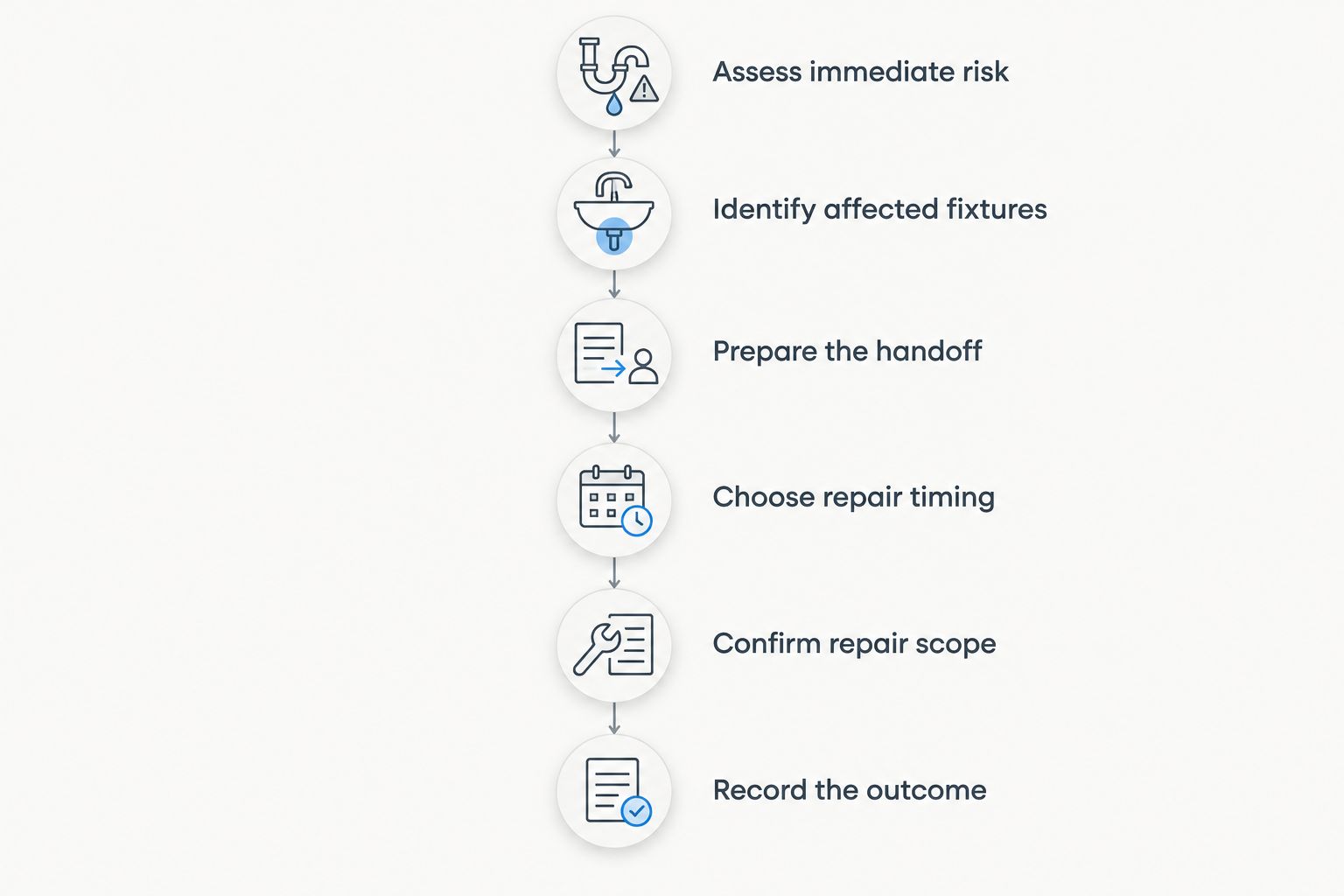
Assess immediate risk
First, determine whether water is escaping, wastewater is backing up or the affected fixture can remain unused. Keep staff and customers away from wet floors and contaminated areas. Do not enter standing water near electrical equipment or touch wet switches.
If you know the relevant water shutoff and can reach it safely, close it to limit a supply leak. Do not force a stuck valve or move through an unsafe area to find one. A container beneath a drip is temporary containment, not permission to leave the fault unattended.
A late-night call should describe what is happening now: whether flow continues, where water is spreading and whether isolation worked. Those facts help establish the next action without guessing at the cause.
- Active leakage: isolate the supply only when safe and keep the area clear.
- Wastewater backup: stop using affected fixtures and restrict access.
- Electrical exposure: stay away from water near outlets, equipment or wiring.
- Stable fixture fault: take the fixture out of use and arrange assessment.
Identify affected fixtures
Walk through the problem with the person who first noticed it. Ask what was in use, when the symptom appeared and whether it has happened before. A toilet that runs after flushing presents a different diagnosis from water appearing around its base.
Check whether the issue affects one fixture or several, without operating fixtures that are overflowing or backing up. Record observations rather than conclusions. Saying that a sink drains slowly and an adjacent toilet gurgles is more useful than declaring that the main drain needs replacement.
Keep any earlier repair notes with the current report. Repeated symptoms deserve attention even when the fixture works normally by the time someone arrives.
- Name the fixture and its room or floor.
- Describe the visible symptom: dripping, pooling, slow drainage or continuous running.
- Note whether nearby fixtures show related symptoms.
- Record when the problem occurs and what activity precedes it.
- Identify earlier work on the same fixture or pipe, if known.
Prepare the handoff
Begin with a simple written note and phone photos; you do not need a maintenance platform to organize a useful repair request. For your 2026 maintenance file, take 3 photos when safe: the affected fixture, the wider location and the visible leak or damage. Never delay isolation to collect pictures.
Name 2 contacts in the note: the person at the premises and the person authorized to approve work. They can be the same individual in a small business, but the roles should be clear. For leased space, verify authorization against your actual building arrangements rather than assuming the business operator can approve every repair.
Once that information is ready, Worry-less offers a service-call route for scheduled repairs and late-night plumbing emergencies. Confirm current availability directly; the existence of an emergency service does not establish an arrival time.
- Give the full business address and affected room.
- Describe the symptom and any safe isolation already completed.
- Provide the on-site contact and approval contact.
- Explain known work restrictions, such as an occupied customer area.
- Ask what information is needed before a visit can be arranged.
Choose repair timing
Choose timing from the condition, not from a search result promising speed. Uncontrolled water, sewage backup or a fault that prevents safe use of the premises needs urgent assessment. A contained faucet drip or an isolated faulty toilet can be considered for a scheduled visit when another suitable fixture remains usable.
For planned repairs, identify a work window that fits the affected area. Describe whether staff need the sink, whether customers pass through the room and whether nearby belongings need moving. Ask the plumber what access is required before changing business arrangements.
Searching for a same-day, weekend or after-hours plumber does not confirm availability. Establish the appointment details directly and avoid telling staff that a repair will be completed before the problem has been assessed.
- Explain whether water is still escaping or wastewater is backing up.
- State whether the affected fixture has been isolated.
- Identify any usable alternative facilities.
- Offer suitable windows for non-urgent work.
- Confirm the visit arrangements before notifying everyone involved.
Confirm repair scope
Ask the plumber to explain the observed fault, the proposed repair and what remains uncertain. A clear scope separates work needed to address the immediate problem from optional follow-up work. Do not authorize a replacement solely because a symptom has returned; ask what the diagnosis shows.
For your 2026 repair records, keep the authorization with the work description. If opening a wall or moving equipment is proposed, establish who approves that work and what reinstatement is included. Avoid assuming that plumbing repair automatically includes every surrounding finish.
Worry-less's emphasis on clear explanations and practical repair advice fits this conversation. You still need the specific diagnosis and agreed scope for your premises; a general description of services cannot replace them.
- Ask which component or pipe section is causing the problem.
- Separate the immediate repair from further investigation.
- Clarify any proposed replacement and why it is needed.
- Confirm access work and responsibility for reinstatement.
- Request approval before additional work outside the agreed scope begins.
Record the outcome
Keep 1 repair log for the premises rather than scattering information across messages. Record the fixture, symptom, diagnosis, completed work and any follow-up recommendation. For a property manager overseeing several units or businesses, identify the exact premises on every entry.
Before returning the area to normal use, ask what was checked and whether any restrictions remain. Do not test a repaired fixture in a way the plumber has advised against. If damage extends beyond the plumbing, record it separately so a stopped leak does not become a forgotten building-maintenance issue.
Use recurring symptoms to plan investigation. Repeated drain clearing or repeated tightening at the same joint should prompt a question about the underlying cause, not an automatic repeat of the previous instruction.
- Record the diagnosis and completed repair in plain language.
- Save supporting photos and the work documentation together.
- Note any remaining restrictions on fixture use.
- Assign responsibility for recommended follow-up.
- Compare new faults with the repair history before booking again.
Compare repair options for small-business premises
Choose the route that matches the condition and required authorization. Safe observation helps you describe the fault, but it is not a substitute for diagnosis. Professional repair and landlord coordination serve different purposes and sometimes need to happen together.
| Option | Best for | Main advantage | Key limitation |
|---|---|---|---|
| Safe observation and isolation | An initial response before assessment | Gives the plumber useful facts and can limit an active supply leak | Does not identify or repair every underlying fault; isolation is only appropriate when safe |
| Scheduled plumbing repair | Stable leaks, faucets, toilets and other faults that can remain out of use | Lets you coordinate access around business activity | Unsuitable for uncontrolled water or sewage backup |
| Late-night emergency plumbing help | Urgent faults discovered outside normal working hours | Provides a route to request urgent assessment | Availability and arrival arrangements require direct confirmation |
| Landlord or property-manager coordination | Leased premises and shared building systems | Establishes approval and building responsibilities | Does not replace immediate safety precautions or plumbing work |
Worry-less handles scheduled plumbing repairs and late-night emergency service calls. Those options support different needs; neither removes the need to describe the fault, confirm the location and agree on the visit. Keep the service decision separate from assumptions about response time.
Common mistakes small businesses make
Treating a working fixture as proof the fault has gone
An intermittent leak or blockage can disappear during a quiet period. Keep the original observations and explain when the symptom appears. Report the pattern, not just the fixture's condition at the time of the call. Do not recreate an overflow to demonstrate it.
Letting authorization remain unclear
A tenant, manager and property owner can each assume someone else has approved the repair. Establish the authorized contact before planned work begins, and explain the situation when requesting urgent help. Do not invent a building-wide access arrangement or approval process where none has been agreed.
Booking without describing business disruption
Saying that a sink is leaking leaves out whether it sits in an unused room or beside equipment. Explain what the affected area supports and what can remain unused. This gives the repair conversation practical context without demanding a completion promise before diagnosis.
Closing the job without recording follow-up
Stopping a leak is not the same as completing every related task. Save advice about further investigation, damaged finishes or restricted fixture use with the repair record. Assign the next action to a named person so the recommendation does not remain buried in a message.
FAQ
What's the best way to arrange plumbing repair services for a small business?
Describe the fault, assess immediate safety and identify who can authorize work before arranging the visit. Give the plumber the premises address, affected fixtures and any safe isolation already completed.
Should I call an emergency plumber for a leaking pipe at work?
Request urgent plumbing help when a pipe leak is uncontrolled or you cannot safely isolate it. Keep people away from affected areas, especially where water is near electrical equipment.
Can a small-business plumbing repair wait for a scheduled appointment?
A stable fault can be considered for a scheduled appointment when the affected fixture can remain safely out of use. Uncontrolled water or sewage backup needs urgent assessment instead.
Does the landlord or business tenant arrange plumbing repairs?
Your lease and building arrangements determine who authorizes and arranges the repair. Contact the responsible person while taking safe steps to limit damage; do not assume every fault belongs to the same party.
Does Worry-less help with late-night plumbing emergencies?
Worry-less handles plumbing service calls including late-night emergencies, alongside scheduled repairs. Confirm whether the premises is served and ask about current availability before making arrangements.
What should I send a plumber before a business-premises visit?
Send a clear symptom description, the fixture location and safe photos if available. Include the on-site contact, approval contact and details of any isolation already completed.
What should a business record after a plumbing repair?
Record the diagnosis, completed work and any restrictions or follow-up recommendations. Keep the information against the specific premises and fixture so a recurring problem can be compared with earlier repairs.
One last thing
Keep the fault history even when the repair seems routine. For your 2026 maintenance folder, connect each new plumbing request to the previous work on that fixture. A useful history tells the next plumber what happened, what changed and what returned—not simply that someone attended.