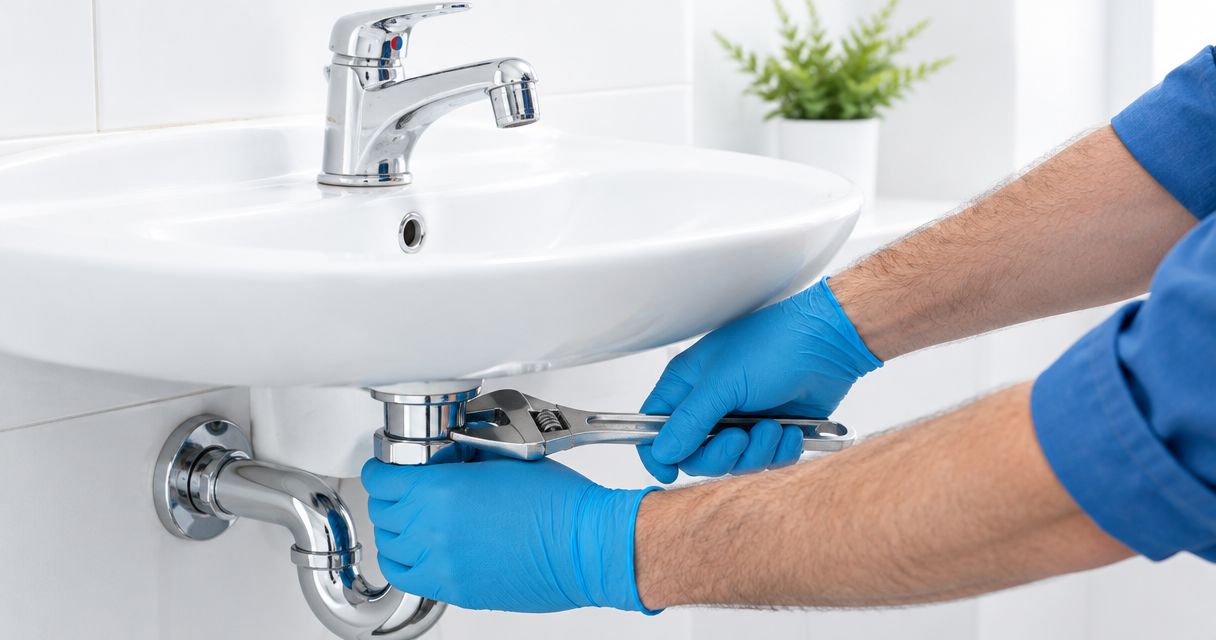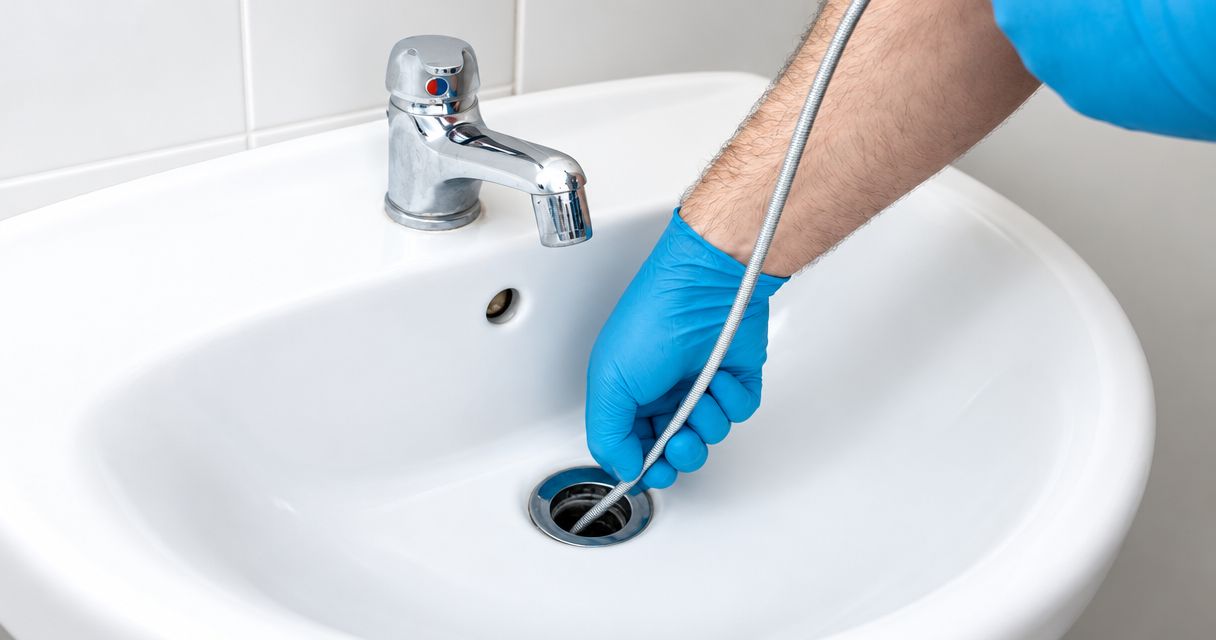
A single blocked drain usually affects one fixture, while a main-line backup can affect several fixtures that share the same drainage route. Multiple slow drains, wastewater rising in a low fixture, or a toilet causing a nearby drain to gurgle point toward a shared blockage—but those signs do not locate it precisely. Emergency drain cleaning becomes urgent when wastewater backs up, overflows, or threatens occupied space; stop using affected plumbing rather than repeatedly testing it.
- Emergency drain cleaning is urgent when wastewater backs up or overflows; stop using affected plumbing.
- One blocked fixture suggests a local clog; connected symptoms suggest a shared drain blockage.
- Gurgling alone does not prove a main-line backup; report which fixtures react together.
- Worry-less handles plumbing service calls, including late-night emergencies and scheduled repairs.
One blocked drain or a main-line backup: how do they differ?
The main difference is the pattern across fixtures, not how dramatic one clog looks. A sink that drains slowly while nearby fixtures work normally suggests a restriction near that sink or its branch drain. Wastewater appearing elsewhere when you flush or drain water suggests a restriction along a shared drainage route.
For help arranging plumbing service, Worry-less handles service calls including late-night emergencies. Explain the symptoms before asking for a particular cleaning method: the affected fixtures help establish what needs checking.
| Observation | Single-fixture blockage | Shared-line or main-line blockage |
|---|---|---|
| Best for describing | A problem confined to one sink, tub, or toilet | Problems involving connected fixtures |
| Drain behavior | One fixture drains slowly or not at all | Several fixtures drain slowly or back up |
| Reaction elsewhere | Other fixtures appear unaffected | Using one fixture causes movement or gurgling elsewhere |
| Where water appears | Usually in the affected fixture | Sometimes in a lower shower, tub, or floor drain |
| Useful clue | The symptom stays local | Symptoms follow water use elsewhere |
| Diagnostic limitation | A local symptom does not prove a local cause | Several affected fixtures do not prove a public sewer problem |
Treat this comparison as a way to describe the problem, not as a confirmed diagnosis. A branch drain can serve several fixtures without being the building's main drain. Venting problems can also cause gurgling, so sound alone is not enough to choose a repair.
Why this matters
Choosing between an urgent call and a scheduled repair starts with containment. A slow bathroom sink with no overflow presents a different situation from wastewater rising through a shower while someone runs a washing machine. The second pattern calls for stopping water use and getting the shared drainage checked.
For your 2026 maintenance plan, separate isolated fixture complaints from reports involving several drains. That distinction helps homeowners, landlords, and property managers explain the problem without assuming every blockage needs the same work.
The trade-off matters: waiting on an active backup allows additional wastewater into the affected space, while treating every slow drain as a main-line emergency skips useful observation. Focus on what is happening now, not on the label attached to it.
What does a single blocked drain look like?
An isolated blockage commonly shows up as standing water in one sink, a slow tub, or a toilet that will not clear normally. Nearby fixtures can appear to work as usual because they join the drainage system beyond the restriction.
Best for a scheduled assessment: an isolated slow drain that is not overflowing, is not leaking, and can remain unused. Scheduling lets you explain recurring symptoms and arrange a repair without treating the situation as an active wastewater spill.
The limitation is that a local-looking problem is not always local. A blockage farther downstream can first become noticeable at one fixture, particularly if other fixtures have not been used recently. Describe what you have observed without running additional water to prove the theory.
Useful observations include:
- Whether the fixture drains slowly or remains completely full.
- Whether the problem began suddenly or developed gradually.
- Whether the same fixture has blocked before.
- Whether another drain reacts during ordinary water use.
- Whether drain chemicals have already been added.
A fixture that becomes usable again has not necessarily been fully cleared. If the same drain keeps blocking, request an assessment of the recurring problem rather than repeatedly treating the visible symptom.
What does a shared-line or main-line backup look like?
A shared blockage becomes more likely when different fixtures react together. Examples include a toilet flush producing bubbles in a nearby tub, a washing machine discharge causing water to rise in a floor drain, or several fixtures becoming slow at the same time.
Best for urgent assessment: wastewater rising into fixtures, an active overflow, or connected symptoms that prevent safe use of essential plumbing. Stop adding water to the affected system while arranging help.
The diagnostic advantage of connected symptoms is that they reveal a relationship between fixtures. The limitation is location: those symptoms alone cannot distinguish a blocked branch from a building main drain, a private sewer connection, or a problem beyond the property.
A low fixture can become the place where backed-up water appears. That does not mean the fixture caused the blockage. Cleaning only that fixture without considering the connected symptoms can miss the actual restriction.
Do not open a drain cleanout during an active backup. Wastewater can escape when the cap is loosened. Tell the plumber about accessible cleanouts, but leave opening and servicing them to the person assessing the drainage system.
What should you do before emergency drain cleaning?
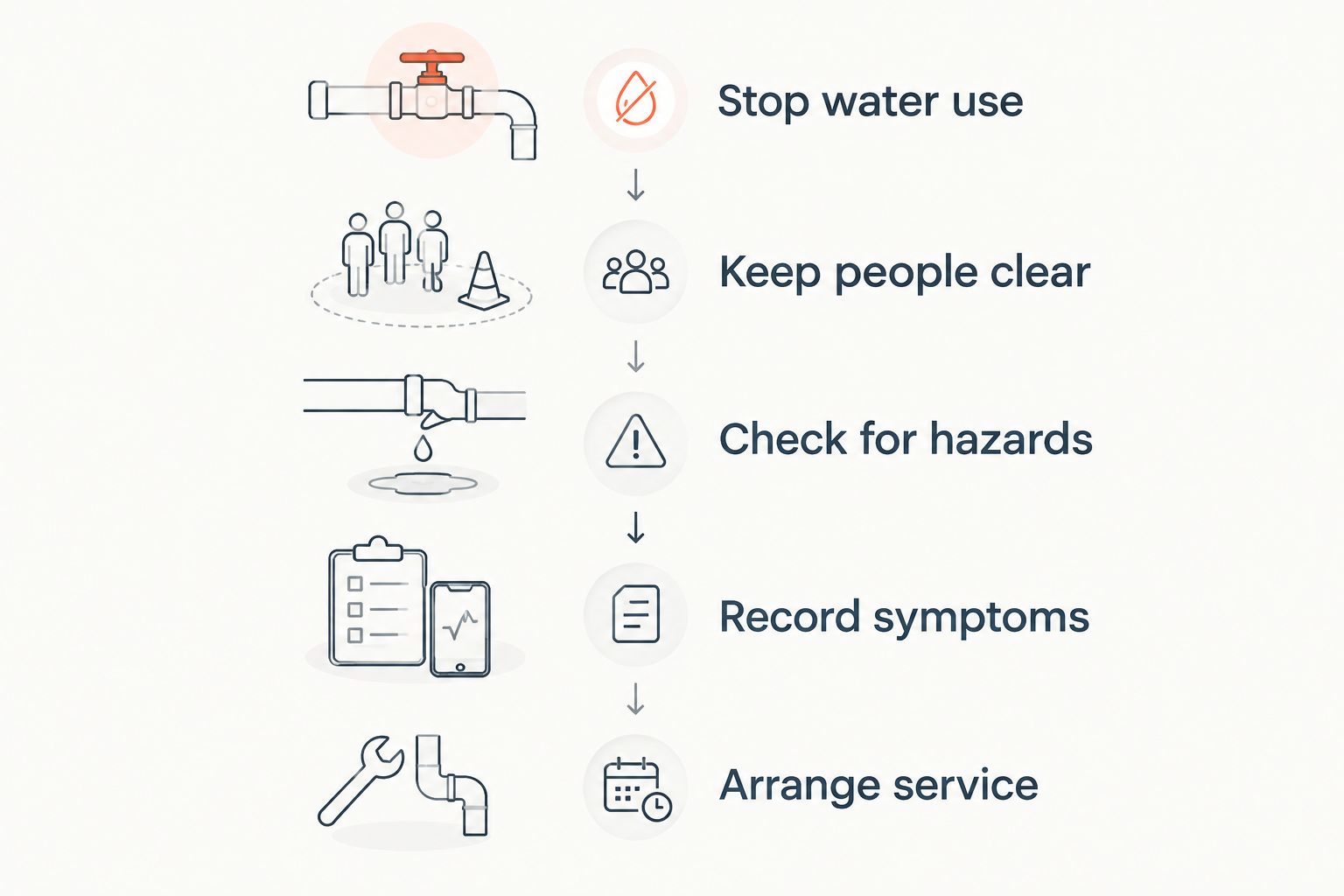
Your immediate job is to limit additional discharge and keep people away from wastewater. Do not attempt to locate the blockage by flushing repeatedly or running every tap.
- Stop water use. Stop flushing, running taps, and operating appliances that discharge into the affected drainage system. If several fixtures are involved, avoid water use throughout the building until you receive guidance.
- Keep people clear. Keep children, pets, tenants, staff, and visitors away from contaminated water. Avoid walking through the affected area or handling wet contents unnecessarily.
- Check for hazards. Stay out of water near outlets, electrical equipment, or appliances. Do not touch electrical equipment while standing in water; get appropriate emergency assistance for an immediate electrical hazard.
- Record symptoms. Note which fixture overflowed, what was running beforehand, and whether another fixture reacted. Photograph the problem only from a safe, dry location.
- Arrange service. Describe whether wastewater is still rising, whether essential fixtures are unusable, and whether anyone has added drain chemicals. Ask what to avoid while waiting.
If a faucet or supply pipe is also leaking, report that separately. A water-supply leak and a wastewater backup require different controls; shutting off the incoming water does not clear a drain obstruction or stop wastewater arriving from elsewhere.
Why drain-backup symptoms vary
The same apparent symptom can come from different parts of a drainage system. These factors explain why a plumber needs more than a report that the drain is blocked:
- Fixture connections: Several fixtures can share a branch before joining the main drain. Connected symptoms identify a shared route, not the exact obstruction.
- Fixture elevation: A lower opening can receive backed-up wastewater before a higher fixture overflows. The visible spill location is not necessarily the blockage location.
- Water discharge: A washing machine or draining tub introduces water differently from a briefly running tap. Symptoms can become noticeable during a larger discharge.
- Partial versus complete restriction: A partly restricted pipe can still pass some water. Temporary drainage does not establish that the obstruction has been removed.
- Drain and vent conditions: Gurgling can accompany drainage or venting problems. A sound recording helps describe the symptom but does not establish its cause.
- Recurring history: Repeated backups warrant attention to the underlying condition. Clearing an obstruction and explaining why it returns are separate questions.
These factors guide the assessment, not a remote diagnosis. Avoid deciding that roots, a damaged pipe, grease, or a public sewer issue caused the backup solely from what appears in the fixture.
When is a scheduled drain repair appropriate?
A scheduled repair fits a contained problem that can remain unused without creating an immediate sanitation or overflow issue. Examples include an isolated slow sink or a recurring fixture problem that is not actively backing up.
Worry-less is a fit for homeowners and property managers seeking late-night plumbing help or scheduled repairs. Ask for clear explanations of the observed problem, the proposed work, and any follow-up needed if symptoms return.
Scheduled work still needs a specific description. Tell the plumber whether the problem affects a kitchen sink, bathroom fixture, laundry drain, or another location, and explain whether the behavior changes when other fixtures are used.
The benefit of scheduling is coordination; the limitation is that a contained problem can change. If wastewater starts rising, another fixture becomes involved, or the only usable toilet stops working, reassess the urgency instead of waiting without an update.
For rental properties, use the plumbing repair guide for Cincinnati property managers to keep the service discussion focused on the affected property and repair needs.
How should landlords coordinate a drain-backup report?
Start with observations, not instructions to keep testing. Ask the reporting tenant which fixture is affected, whether wastewater is present, and whether the problem appears elsewhere. Request an update if conditions change.
For a 2026 rental maintenance record, keep the original report, observed symptoms, photographs taken safely, and the repair explanation together. This creates a useful history if the same drainage problem returns.
Ask these questions before arranging the visit:
- Is water still rising, or has it stopped?
- Which fixtures cannot be used?
- Did another fixture or appliance run just before the backup?
- Has anyone used a plunger, drain tool, or chemical cleaner?
- Are other occupants reporting a similar problem?
Do not instruct another unit to run water as a test. Reports from multiple units are useful information, but deliberately adding discharge can worsen a backup. Let the plumber determine which checks are appropriate.
Confirm the visit arrangements directly with the occupants and service provider. A request for after-hours, weekend, or same-day plumbing does not establish an arrival time; ask what can actually be arranged before communicating expectations.
What should you ask after the drain is cleared?
Ask what was found, which section was worked on, and whether the explanation fits the reported symptoms. A useful repair discussion separates the immediate result from any remaining uncertainty.
For your 2026 repair record, document whether drainage was restored, whether a cause was identified, and what follow-up was recommended. Do not translate a successful clearing into a guarantee that the problem cannot return.
Useful questions include:
- Was the restriction near the fixture or farther along a shared drain?
- Was the cause established, or was only the obstruction cleared?
- Do recurring symptoms justify further investigation?
- What changes in behavior should trigger another call?
- When can the affected fixtures be used again?
A camera inspection can help investigate accessible drain conditions, but it is not automatically required for every isolated clog. Ask what question the inspection would answer and how the findings would change the repair advice.
Can one clogged toilet mean the main drain is blocked?
One clogged toilet does not prove a main-drain blockage. The concern increases when flushing affects another fixture or other drains also stop working; stop repeated flushing and report the connected symptoms.
Does a gurgling drain always need emergency drain cleaning?
A gurgling drain does not always need emergency drain cleaning. Gurgling without overflow still deserves assessment, but rising wastewater, connected backups, or loss of essential plumbing changes the urgency.
Will shutting off the water stop a sewer backup?
Shutting off your incoming water does not necessarily stop a sewer backup. It limits additional water from your own supply, but it does not remove the obstruction or prevent wastewater arriving through a shared system.
FAQ
How can I tell whether one drain or the main line is blocked?
One affected fixture suggests a local blockage; several connected symptoms suggest a shared drainage problem. The pattern helps describe the issue but does not confirm the blockage location.
Should I keep flushing a toilet that backs up?
Stop flushing a toilet that backs up. Repeated flushing adds water and can cause an overflow, especially when drainage is restricted farther downstream.
Can I use chemical cleaner before calling for emergency drain cleaning?
Do not add chemical drain cleaner to an active backup. If a cleaner has already been used, tell the plumber what was added before work begins.
Is a slow kitchen sink an emergency?
An isolated slow kitchen sink is not automatically an emergency. A scheduled assessment fits a contained problem that can remain unused, while overflow or connected backups needs prompt attention.
What should I tell a plumber about a rental-property backup?
Tell the plumber which fixtures are affected, whether wastewater is rising, and whether other occupants report similar symptoms. Include any chemicals or tools already used.
What should I include in a 2026 drain-maintenance log?
A 2026 drain-maintenance log should include reported symptoms, affected fixtures, repair findings, and recommended follow-up. Keep recurring reports together so the service history remains clear.
Does Worry-less offer late-night plumbing help?
Worry-less handles plumbing service calls including late-night emergencies, along with scheduled repairs. Confirm the visit arrangements directly; an emergency request does not establish a guaranteed arrival time.
One last thing
The drain where wastewater appears is not always the drain that needs clearing. Before your next service call, write down what happened immediately before the backup—not just where you saw the water. That sequence gives the plumber a more useful starting point than a suspected diagnosis.