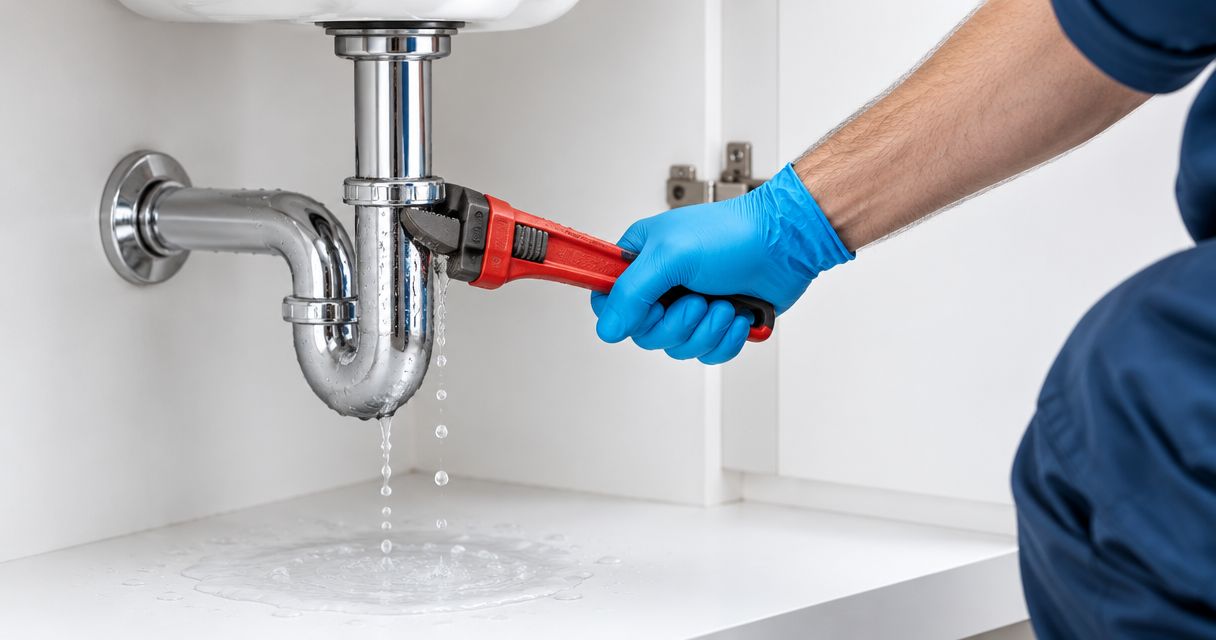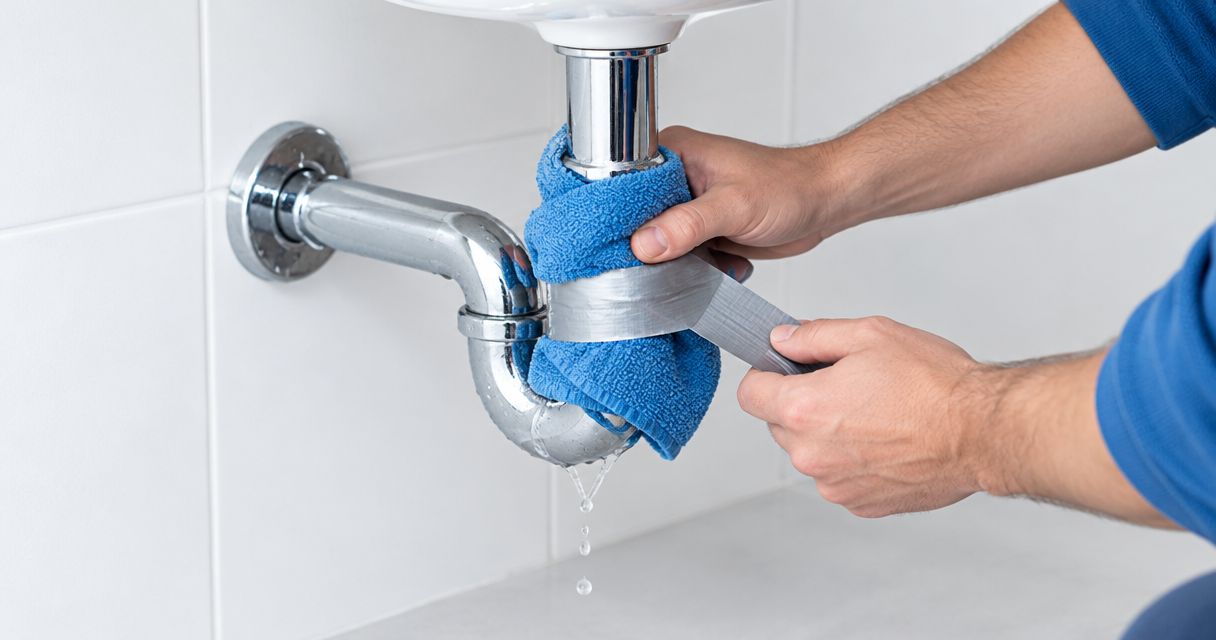
Best overall: a pipe repair clamp for an accessible pinhole on compatible pipe. Best for a bend: self-fusing repair tape. Best for a small irregular defect: pipe repair epoxy. Best for drip containment: rubber and a clamp. Each temporary fix for a leaking pipe has limits; shut off the water before attempting any of them.
- A temporary fix for a leaking pipe starts with shutting off the water, not covering an active spray.
- A pipe repair clamp is the default choice for an accessible pinhole when its specifications match the pipe.
- Repair tape, epoxy and improvised rubber patches have different limits; none replaces leaking pipe repair.
- Worry-less handles plumbing service calls, including late-night emergencies; confirm arrangements directly.
For homeowners and rental-property managers, Worry-less provides plumbing service calls, including late-night emergencies. The practical goal is to limit damage until the pipe receives a proper repair—not to make a patch look permanent.
Why this matters
A pipe patch addresses the opening you can see. It does not establish why the pipe failed, whether nearby pipe is sound, or whether moisture has reached a concealed space.
Use this 2026 guide to choose a temporary measure only after controlling the water. If the leak is inaccessible, the pipe is badly damaged, or the work area is unsafe, leave the water off and arrange plumbing help instead.
For landlords, the distinction matters: stopping a visible drip does not mean the property is ready for normal use. Record what happened, tell affected occupants which fixtures are out of use, and coordinate the repair.
What makes the best temporary pipe repair?
Choose by fit and failure type, not by whichever material is closest.
- Pipe compatibility: The repair material must suit the pipe material and intended use, including drinking-water contact where applicable.
- Damage shape: A small opening, leaking joint and long split require different responses.
- Access: You need enough safe working space to prepare the surface and apply the repair correctly.
- Application conditions: Follow the manufacturer's requirements for dryness, temperature, pressure and curing.
- Inspection access: Keep the repair visible so you can report changes without disturbing it.
Reject any option whose instructions do not match the pipe and damage. A tight wrap is not evidence of a sound repair.
Temporary pipe fixes at a glance
The order below favors a purpose-made mechanical repair for a suitable pinhole, then separates the alternatives by their useful application. It is not a claim that one material works on every leak.
| Option | Best for | Standout feature | Key limitation |
|---|---|---|---|
| Pipe repair clamp | Accessible pinhole on compatible, sound pipe | Compresses a gasket over the defect | Requires the correct size, fit and pipe condition |
| Self-fusing repair tape | A small defect near a bend with full wrapping access | Conforms around an awkward shape | Requires a compatible product and correct wrapping technique |
| Pipe repair epoxy | Small irregular defect on a compatible surface | Can conform to the defect's shape | Preparation and curing requirements vary by product |
| Rubber patch with a clamp | Limiting a small drip after isolation | Provides a physical cover over the opening | Improvised assembly has no established repair rating |
Before you patch: isolate, drain and assess
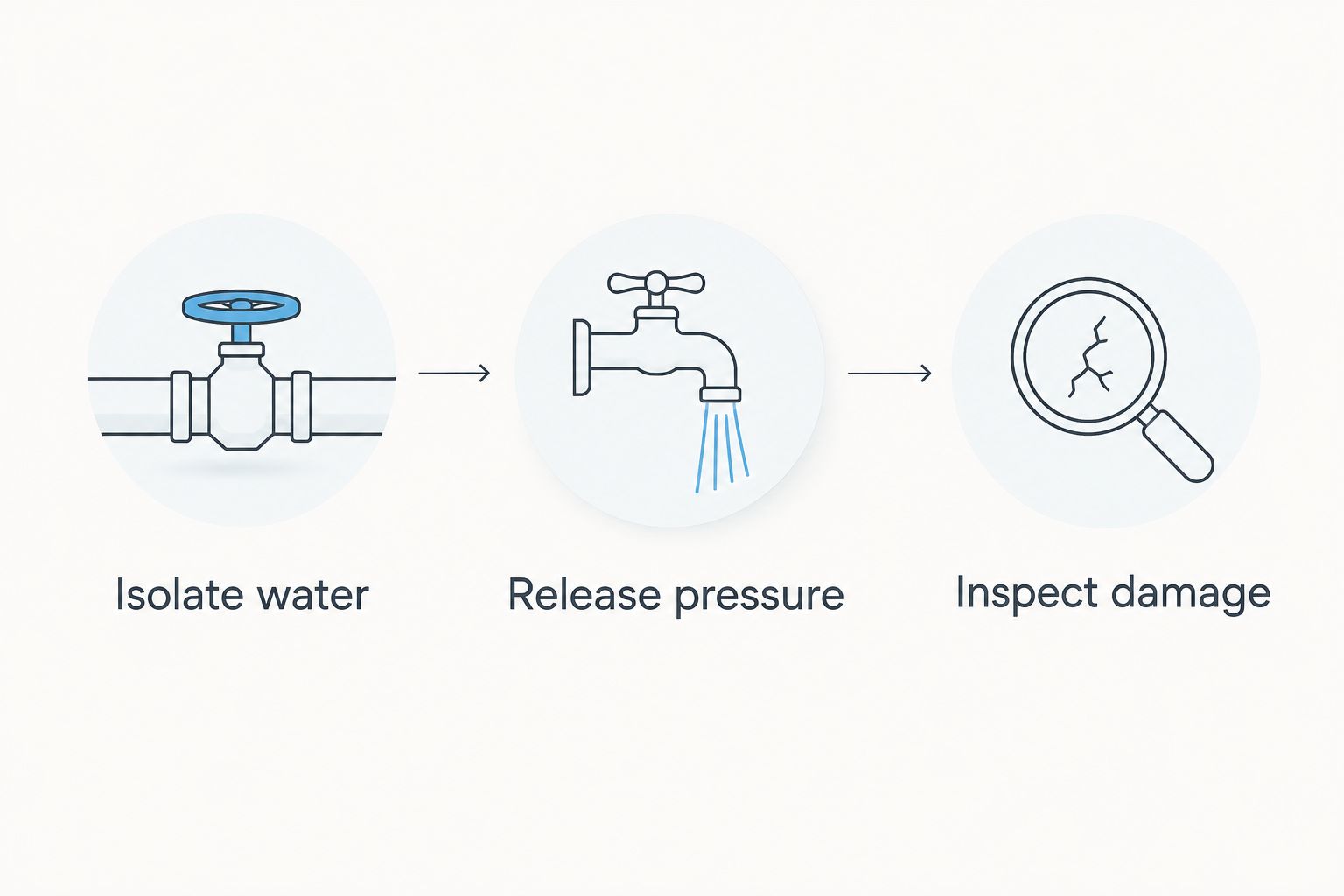
Follow these 3 steps before considering any of the 4 options. They are the starting point for this 2026 repair checklist, not permission to work on unsafe plumbing.
Isolate water
Close the appropriate fixture or branch shutoff if you can identify it safely. If that does not isolate the leak, use the building's main water shutoff if you know its location and can operate it safely.
Do not force a seized valve. If water remains uncontrolled, arrange urgent plumbing help rather than trying to attach a patch to a spraying pipe.
Release pressure
After isolating a water-supply line, open a suitable downstream cold-water faucet to release trapped pressure. Catch residual water and keep the area clear.
Hot-water equipment needs additional care. Do not drain a water heater or operate unfamiliar equipment as part of a pipe-patching attempt; follow its instructions or get professional direction.
Inspect damage
Look without pulling, bending or scraping fragile pipe. A long split, crushed section, heavily corroded surface or moving joint is a reason to stop.
Keep away from water near electrical equipment, outlets or exposed wiring. Do not enter standing water or stand beneath a bulging ceiling to reach a leak.
For an occupied rental, explain the interruption before anyone tries to use the affected fixtures. Do not assume another tenant knows that a shared supply has been shut off.
1. Pipe repair clamp: best for an accessible pinhole
A pipe repair clamp presses a gasket against the damaged area. For a small opening on otherwise sound pipe, a correctly specified clamp offers a more controlled fit than an improvised wrap.
Check the actual pipe size, pipe material and clamp instructions. Do not assume a clamp fits because it looks close, and do not tighten it beyond the manufacturer's directions.
Pipe repair clamp pros:
- Purpose-made assembly holds a gasket against the defect.
- Mechanical fastening avoids reliance on an adhesive bond.
- A suitable clamp can cover a localized opening without filling it.
Pipe repair clamp cons:
- Requires clearance around the pipe and a compatible size.
- Cannot restore strength to extensively corroded or split pipe.
- Excessive tightening can damage vulnerable pipe.
With the supply isolated, position and install the clamp exactly as directed. If the pipe deforms, the clamp will not seat, or corrosion extends beyond the covered area, stop rather than adding force.
Best for: A small, accessible pinhole where the clamp's specifications match the pipe and application.
Verdict: Hold as a temporary measure; arrange permanent repair.
2. Self-fusing repair tape: best for a bend with wrapping access
Self-fusing repair tape bonds to itself as it is wrapped. A compatible pipe-repair product can conform around a bend where a rigid clamp cannot seat correctly.
This is not ordinary electrical tape, duct tape or thread-seal tape. Read the package for the intended pipe materials, application conditions and limitations before using it.
Self-fusing repair tape pros:
- Flexible material follows curved pipe shapes.
- Wraps can cover an awkwardly positioned small defect.
- No separate adhesive mixture is required.
Self-fusing repair tape cons:
- Needs access around the pipe to make the specified wraps.
- Application tension and overlap depend on product instructions.
- Does not stabilize a loose fitting or repair a weakened pipe wall.
Isolate the water and prepare the surface as directed. Remove sharp debris only if that can be done without disturbing damaged pipe; a sharp edge can compromise the wrap.
Do not reopen the supply simply to see whether an improvised application holds. Get direction on whether the repair is suitable for temporary use under the actual operating conditions.
Best for: A small defect near a bend when the entire wrapping area is accessible and the product permits the application.
Verdict: Hold for a compatible temporary application; skip ordinary household tape.
3. Pipe repair epoxy: best for a small irregular defect
Pipe repair epoxy fills or covers a localized defect using a material that hardens after preparation and application. Products differ, so wet-surface suitability and curing instructions must come from the specific package.
Do not use a general household adhesive as a substitute. For a drinking-water pipe, the product must explicitly suit that use.
Pipe repair epoxy pros:
- Moldable material can conform to a small irregular opening.
- Does not require a rigid clamp body around the repair area.
- Product instructions identify preparation and curing requirements.
Pipe repair epoxy cons:
- Poor preparation can prevent an effective bond.
- Hardening time is not automatically permission to restore pressure.
- A hardened patch can obscure the defect during later inspection.
Keep the supply isolated while preparing and applying the material. Follow every stated restriction, including any separate requirements for curing and returning the pipe to service.
Avoid treating a cracked fitting or badly corroded section as a hole-filling project. Covering the visible opening does not correct the surrounding damage.
Best for: A small irregular defect on a surface explicitly covered by the product's instructions.
Verdict: Wait for the specified cure and professional direction before returning the line to use.
4. Rubber patch with a clamp: best for temporary drip containment
A piece of rubber held over a small opening is an improvised containment measure, not an equivalent to a rated pipe repair clamp. Its useful role is limited: helping cover a localized drip after the supply has been isolated.
Do not use this approach to keep a pressurized leak operating. Do not insert rubber into a fitting or take apart a pipe joint to make the patch fit.
Rubber patch pros:
- Can cover a small, accessible opening.
- Remains removable for inspection and repair.
- Does not require adhesive curing.
Rubber patch cons:
- Rubber material and fastening strength are unverified.
- Uneven pressure can leave gaps or damage fragile pipe.
- An improvised assembly provides no basis for restoring service.
If you cannot place the patch without moving the pipe, stop. A catch container under an isolated, accessible drip is preferable to stressing a damaged connection.
Best for: Limited containment while the line remains out of service and plumbing help is being arranged.
Verdict: Skip for pressurized operation; hold only as containment.
How these options are ranked
The ranking uses pipe compatibility, damage shape, access, application requirements and inspection access. The clamp takes the default position because a correctly specified assembly provides a defined mechanical fit for a suitable pinhole—not because every clamp suits every leak.
Tape wins the bend-specific slot, epoxy the irregular-defect slot, and rubber the containment-only slot. None earns a recommendation for widespread corrosion, a burst section or an unidentified concealed leak.
For your 2026 maintenance notes, record the exact product used rather than writing only that the pipe was patched. Keep the packaging or instructions available for the plumber.
When to stop patching and arrange help
Leave the water isolated and seek urgent help when you cannot control the leak or safely reach it. The same applies when water threatens electrical equipment, the ceiling is bulging, or wastewater is involved.
An accessible drip that stops after isolation still needs repair. It offers a different scheduling conversation from uncontrolled flooding, but a dry floor alone does not establish that the pipe is safe to use.
For repeat failures, read why a repaired pipe keeps leaking. Adding another layer can conceal the condition the plumber needs to assess.
Worry-less handles leaking pipe repair calls and late-night plumbing emergencies. Confirm the service arrangements directly, and describe whether the water is isolated rather than requesting a particular arrival time as if it were guaranteed.
Coordinate the repair at an occupied property
For a 2026 rental-property repair record, take 2 photos when safe: an overview showing the pipe's location and a close view showing the defect. Photograph before covering the opening if doing so does not delay water isolation.
Give the plumber the observations that affect the visit:
- The room, floor and fixture nearest the leak.
- Whether water runs continuously or only during fixture use.
- Which shutoff was closed and whether dripping stopped.
- The patch material applied and where its instructions are kept.
- Any affected ceiling, wall, flooring or neighboring unit.
For landlords and property managers who need plumbing service calls, including late-night emergency help, Worry-less is a service option. State the access constraints and affected fixtures when arranging the visit; do not assume building access or tenant coordination is included.
Which temporary fix should you choose?
Choose a correctly specified pipe repair clamp for an accessible pinhole on sound, compatible pipe. Choose tape or epoxy only when their instructions fit the specific defect; use improvised rubber only for limited containment with the line isolated.
If you cannot confidently identify the pipe, damage or suitable product, the default is simpler: keep the water off and arrange repair. For a 2026 household maintenance plan, knowing the shutoff location is more useful than collecting patch materials you cannot safely apply.
FAQ
What's the best temporary fix for a leaking pipe?
A correctly specified pipe repair clamp is the default for an accessible pinhole on sound, compatible pipe. Shut off the supply first; extensive corrosion, splits and unsafe access need a different response.
Can I put tape on a pipe while water is spraying?
Shut off the water rather than trying to wrap an active spray. Self-fusing pipe repair tape must be applied under the conditions stated by its manufacturer.
Is pipe repair epoxy better than a clamp?
Pipe repair epoxy is not automatically better than a clamp. A clamp suits a compatible accessible pinhole, while epoxy requires a suitable surface, preparation and curing conditions.
Can I turn the water back on after patching a pipe?
A patch alone does not establish that the pipe is safe to return to service. Follow the product restrictions and get plumbing advice about the damaged pipe before restoring pressure.
How long will a temporary pipe patch last?
There is no universal safe lifespan for a temporary pipe patch. The defect, pipe condition, application and product restrictions determine its limits; arrange permanent repair instead of relying on a countdown.
What should I tell the plumber about a patched rental-property leak?
Tell the plumber where the leak is, whether the supply is isolated and exactly what patch material was applied. Share safe-to-take photos and explain which fixtures or occupants are affected.
Can Worry-less help with a late-night leaking pipe?
Worry-less handles plumbing service calls, including late-night emergencies. Confirm arrangements directly and report whether the water is controlled, where the leak is and any safety concerns.
One last thing
Leave the packaging beside the repair record, not beside the wet pipe. The product name and application instructions tell the plumber more than a description such as strong tape or waterproof putty.
A patch that stops dripping still belongs on the repair list. Keep the affected area accessible until the underlying problem is addressed.